
How Should I Save for my Salary? The Myth of the Magic Savings %
Updated: Sep 21
And the case for consumption smoothing over flat savings.
The standard financial advice: save a fixed percentage every year. Dave Ramsey says invest 15% of your gross income. Many planners recommend 10-20% throughout your career. Simple math. Set it and forget it. The problem? This treats all dollars the same, when the first $50,000 you earn and the second $50,000 are doing fundamentally different work in your life.
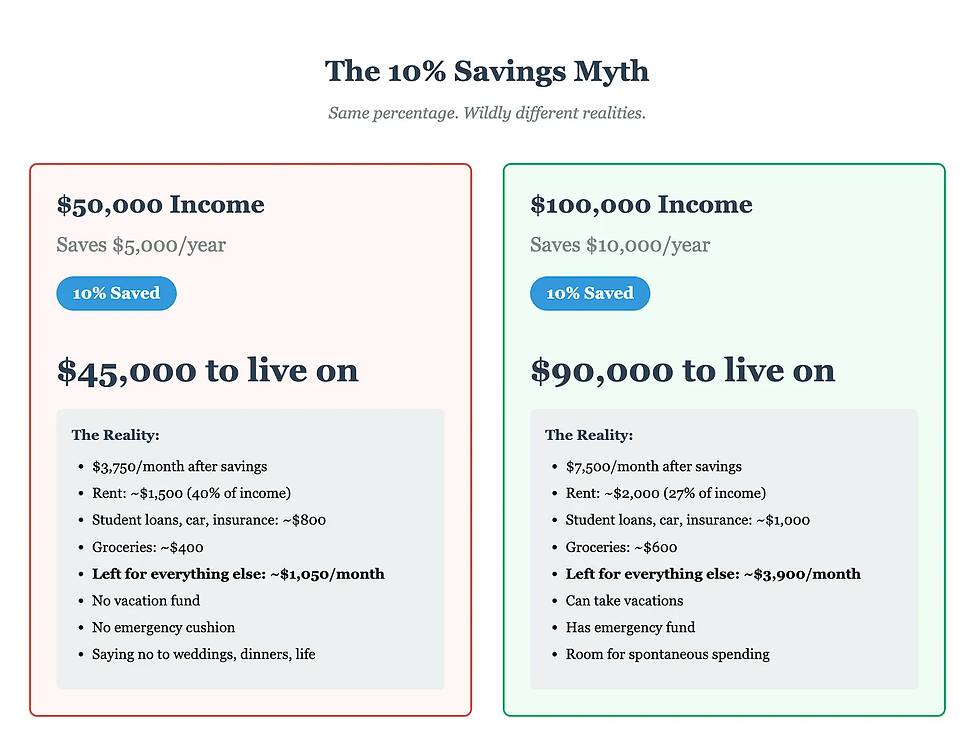
If you’re making $50,000 and saving $5,000 a year, you’re performing financial acrobatics. You’re saying no to nearly everything optional. Someone making $100,000 who saves $10,000? The math is identical, but the human experience is not. Yet the gurus tell both people they’re equally disciplined savers, when one is scraping by while the other still has room for a vacation fund.
This desperation to gain control has spawned movements like “No Spend January,” highlighted in today’s Wall Street Journal, where people commit to buying nothing non-essential for an entire month. This is a neat idea, although in personal experience, likely leads to double the spending in February. The reality is you can’t willpower you’re way into living on a $50,000 budget in a city with a $75,000 basic cost of living. Delaying the purchase of things you need by a month won’t make you need them any less.
The flat savings model also ignores that different life stages are inherently more expensive. When you have pre-kindergarten age kids, you're paying $2,000+ per month for childcare while simultaneously trying to avoid career stagnation and likely not yet at your peak earning years. This may not be the time to obsess over maxing out your IRA for retirement 50 years down the road. The priority may need to be keeping your family healthy, educated, and cared for while maintaining the career momentum that will eventually fund that retirement. A 30-year-old parent saving 5% while paying for two kids in daycare is making a more rational choice than the guru who insists they should be hitting 15% no matter what. That same person at 45, with kids in public school and a higher salary, can save 25% without breaking a sweat.
So, how should I save for my salary?
This is where consumption smoothing makes sense. As your income grows, resist inflating your lifestyle at the same pace. Maintain roughly the same spending level you had at $50,000 when you’re earning $100,000, and suddenly you’re saving 30-50% without deprivation. The incremental dollars aren’t fighting for survival—they can build wealth. It’s reasonable to save less when you earn less, and significantly more when you earn more.

In this example, if you’re making $50,000 net and saving anything—even 3-5%—you’re winning. But when your net income jumps to $80,000 or $100,000, that’s when the game changes. Keep your rent the same, don’t upgrade your car just because you can, resist the lifestyle creep, and suddenly you’re saving real money without the existential dread. The gurus want to make it sound simple, but what actually works is meeting yourself where you are and scaling your savings as your capacity grows—not your guilt.

Ms. Money is written by Marisa Rothstein, JD, CFP(t), AEP, and Lead Financial Advisor at Siena Private Wealth, A Member of Advisory Services Network, LLC.
Nothing contained in this article should be construed as investment, legal or tax advice. Consult your tax or legal advisor regarding your situation. To learn more about Siena Private Wealth, visit: www.sienaprivate.com. All information contained herein is derived from sources deemed to be reliable but cannot be guaranteed. All views/opinions expressed in this newsletter are solely those of the author and do not reflect the views/opinions held by Advisory Services Network, LLC.


Comments